
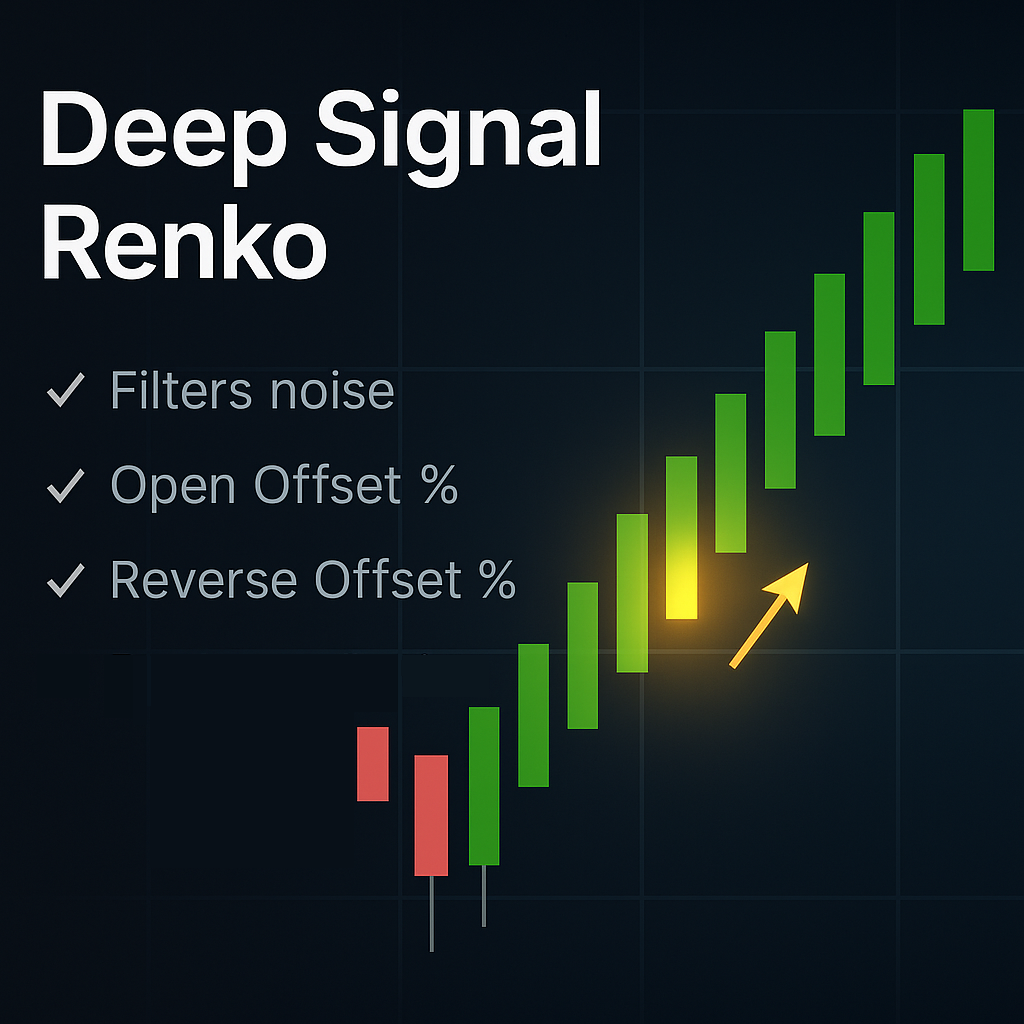
Deep Signal Renko is a price-driven bar type that constructs bricks based strictly on movement in ticks rather than elapsed time. The objective is to normalize price action by filtering minor fluctuations while preserving directional structure. Brick formation is controlled by three primary parameters: Brick Size, Open Offset %, and Reversal %. Together, these parameters define how price transitions are represented and how sensitive the chart is to continuation versus reversal.
Unlike traditional time-based charts, Deep Signal Renko only updates when price movement exceeds predefined thresholds. This ensures each brick represents a meaningful change in price and maintains consistent structural logic regardless of market speed.
Brick Size (Ticks)
Brick Size specifies the minimum price movement, measured in ticks, required to generate a new brick in the current direction. No brick is printed until price has moved at least this distance from the previous brick’s reference level.
A larger Brick Size reduces chart sensitivity by filtering smaller oscillations, resulting in smoother trend visualization. A smaller Brick Size increases sensitivity and produces more frequent bricks, capturing short-term price structure. This parameter functions as the primary volatility filter and directly impacts trade signal density and chart granularity.
Open Offset %
Open Offset % defines the relative opening position of the next brick compared to the prior brick. Instead of forcing the next brick to open at the previous close, the offset introduces a proportional shift that modifies how overlapping or separation between bricks is represented.
This adjustment affects visual continuity and perceived momentum. Higher offset values increase spacing and emphasize directional extension, while lower values produce tighter brick transitions. The offset mechanism allows traders to control how aggressively price progression is compressed or expanded on the chart without changing the underlying Brick Size.
Reversal %
Reversal % determines the amount of counter-directional movement required to print a brick in the opposite direction. The threshold is calculated as a percentage of the Brick Size, rather than a fixed value.
A higher Reversal % increases resistance to direction changes, requiring stronger confirmation before a reversal brick is formed. This reduces whipsaw behavior in trending markets. A lower Reversal % allows quicker reversals and increases responsiveness in rotational or range-bound environments. The parameter acts as a directional stability control and directly influences how trend persistence is displayed.
Parameter Interaction
Brick Size, Open Offset %, and Reversal % operate as a combined system. Brick Size sets the base movement unit, Open Offset shapes structural continuity, and Reversal % governs directional confirmation. Adjusting one parameter changes how the others are perceived, so tuning is typically performed relative to instrument volatility and trading style.
Proper configuration allows the chart to balance responsiveness and stability, providing a consistent structural framework for discretionary or automated strategies.
Futures, foreign currency and options trading contains substantial risk and is not for every investor. An investor could potentially lose all or more than the initial investment. Risk capital is money that can be lost without jeopardizing ones financial security or lifestyle. Only risk capital should be used for trading and only those with sufficient risk capital should consider trading. Past performance is not necessarily indicative of future results.