
Deep Signal VPIN (Volume-Synchronized Probability of Informed Trading)
Overview
Deep Signal VPIN is a market microstructure indicator designed to measure order flow toxicity—the likelihood that informed traders are dominating the market.
Rather than relying on price alone, VPIN analyzes the imbalance between buying and selling volume over time, helping traders identify when markets are stable… and when they may be vulnerable to sharp, directional moves.
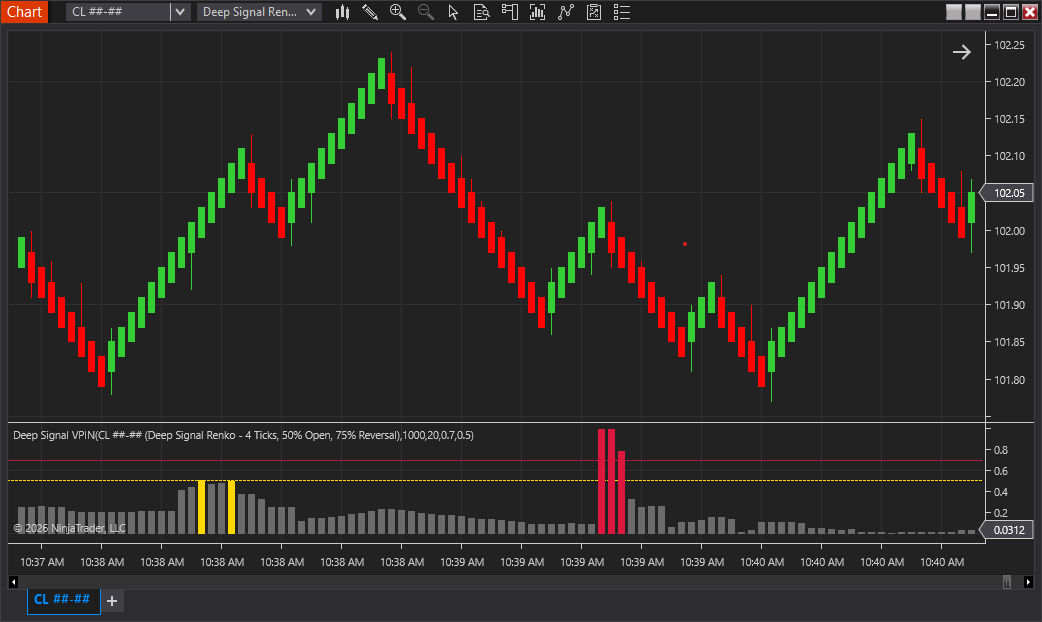
VPIN values range from 0 to 1, providing a normalized view of market conditions:
- Low values (near 0) → Balanced, stable order flow
- High values (near 1) → Imbalanced, potentially toxic order flow
How VPIN Works
VPIN is calculated by grouping trades into equal-volume buckets instead of fixed time intervals. Within each bucket, the algorithm estimates the imbalance between buying and selling pressure.
The result is a rolling measure of how “one-sided” the market has become.
Key Concepts
- Volume Buckets
Trades are aggregated until a predefined volume threshold is reached. - Order Flow Imbalance
The difference between estimated buy volume and sell volume within each bucket. - Rolling Average
VPIN smooths recent imbalances to produce a continuous indicator between 0 and 1.
Interpretation
VPIN Scale
- 0.0 – 0.3 (Low Toxicity)
- Balanced participation
- Efficient price discovery
- Favorable for mean reversion and stable trends
- 0.3 – 0.7 (Moderate Activity)
- Normal trading conditions
- Mixed participation
- Monitor for emerging imbalance
- 0.7 – 1.0 (High Toxicity)
- Strong order flow imbalance
- Increased risk of volatility spikes
- Potential informed trading or directional pressure
How to Use VPIN
Core Use Case
Use VPIN as a market condition filter—not a standalone entry signal.
It answers the question:
“Is this move supported by stable participation… or driven by aggressive, imbalanced flow?”
Practical Applications
1. Trade Filtering
- Low VPIN → Favor breakout continuation or structured setups
- High VPIN → Be cautious; expect instability or sharp reversals
2. Risk Management
- Rising VPIN suggests:
- Widen stops
- Reduce position size
- Avoid overconfidence in signals
3. Volatility Awareness
- Spikes in VPIN often precede:
- News-driven moves
- Liquidity gaps
- Sudden directional expansion
Strategy Guidelines
Scalping
- Prefer low to moderate VPIN (0.2 – 0.5)
- Avoid entering during sharp VPIN spikes
- Use VPIN to confirm stable execution conditions
Intraday / Momentum
- Monitor rising VPIN for potential breakout fuel
- Combine with order flow or trend indicators (e.g., Cobra, OTR)
Swing Trading
- Sustained high VPIN can indicate:
- Institutional positioning
- Strong directional bias
- Look for alignment with higher timeframe structure
Best Practices
- Do not use VPIN alone
Combine with price action, structure, or other Deep Signal tools - Watch for transitions
The shift from low → high VPIN is often more important than the absolute value - Adapt to instrument
- Futures (ES, NQ): VPIN reacts quickly to flow changes
- Stocks: May require tuning of bucket size
- Use with volume-based charts (recommended)
Tick, Renko, or volume bars can enhance VPIN responsiveness
Example Workflow
- Identify a trade setup (e.g., Cobra signal or breakout)
- Check VPIN:
- Low VPIN → Proceed with confidence
- High VPIN → Reduce risk or wait for stabilization
- Monitor VPIN during trade:
- Rising VPIN → expect volatility expansion
- Falling VPIN → trend stabilization
Summary
Deep Signal VPIN provides a powerful lens into who is driving the market—and how aggressively.
- It reveals when liquidity is real vs. deceptive
- It highlights conditions where risk is elevated
- It helps traders align with true market participation
Used correctly, VPIN becomes a critical tool for improving timing, risk control, and trade quality.
Futures, foreign currency and options trading contains substantial risk and is not for every investor. An investor could potentially lose all or more than the initial investment. Risk capital is money that can be lost without jeopardizing ones financial security or lifestyle. Only risk capital should be used for trading and only those with sufficient risk capital should consider trading. Past performance is not necessarily indicative of future results.