
Deep Signal VPIN – Parameters
This section describes each configurable parameter for the VPIN indicator and how it affects behavior, responsiveness, and visualization.
Overview
Deep Signal VPIN measures order flow toxicity by analyzing the imbalance between buying and selling volume within fixed-size volume buckets.
It produces a value between 0 and 1:
- 0 → Balanced, low-risk market conditions
- 1 → High imbalance, elevated risk / informed trading activity
VPIN helps traders identify when the market is becoming:
- Efficient and stable
- Unstable, aggressive, or dominated by informed participants
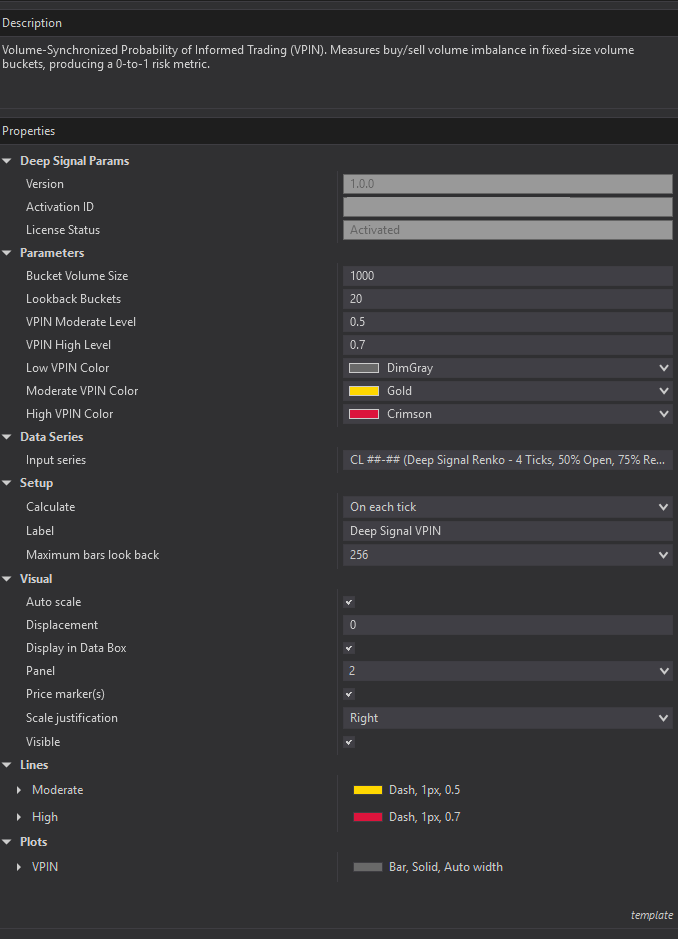
Here is the Properties dialog that contains the VPIN parameters.
Parameters
Bucket Volume Size
Default: 1000
Description:
Defines the total volume required to form a single VPIN bucket.
Instead of using time-based bars, VPIN aggregates trades until this volume threshold is reached.
Usage:
- Smaller values (e.g., 500–1000):
- More responsive
- Better for scalping / fast markets
- Larger values (e.g., 2000–5000):
- Smoother signal
- Better for trend and swing analysis
Lookback Buckets
Default: 20
Description:
Number of completed volume buckets used to calculate the VPIN value.
This determines how much historical imbalance is considered.
Usage:
- Lower values (10–20):
- Faster reaction to changes
- More sensitive but noisier
- Higher values (30–50):
- Smoother, more stable signal
- Slower to react
VPIN Moderate Level
Default: 0.5
Description:
Threshold that defines moderate imbalance / rising market risk.
When VPIN exceeds this level:
- Market begins transitioning from balanced → imbalanced
- Early warning of potential instability
VPIN High Level
Default: 0.7
Description:
Threshold that defines high imbalance / elevated toxicity.
When VPIN exceeds this level:
- Strong indication of informed trading or aggressive order flow
- Market conditions may become:
- Volatile
- Less predictable
- Prone to sharp moves
Low VPIN Color
Default: DimGray
Description:
Color used when VPIN is below the Moderate Level.
Interpretation:
- Balanced order flow
- Lower risk environment
- More stable price behavior
Moderate VPIN Color
Default: Gold
Description:
Color used when VPIN is between:
- Moderate Level and High Level
Interpretation:
- Increasing imbalance
- Market transitioning into higher risk conditions
- Traders should become more cautious
High VPIN Color
Default: Crimson
Description:
Color used when VPIN exceeds the High Level.
Interpretation:
- Strong imbalance
- Elevated probability of informed or aggressive trading
- Increased likelihood of:
- Sharp moves
- Liquidity gaps
- Stop runs
Visual Elements
VPIN Plot
Displayed as a histogram:
- Values range from 0 to 1
- Color-coded by risk level:
- Gray → Low risk
- Gold → Moderate risk
- Red → High risk
Moderate Line
Horizontal reference line at the VPIN Moderate Level:
- Indicates transition into rising imbalance
High Line
Horizontal reference line at the VPIN High Level:
- Marks extreme imbalance conditions
Interpretation Guide
Low VPIN (< 0.5)
- Balanced buying and selling
- Efficient market conditions
- Better for:
- Trend continuation
- Structured setups
Moderate VPIN (0.5 – 0.7)
- Growing imbalance
- Early signs of stress
- Watch for:
- Breakouts
- Regime shifts
High VPIN (> 0.7)
- Strong imbalance / informed activity
- Market may become:
- Unstable
- Volatile
- Reactive
Best Practices
Scalping
- Use smaller Bucket Volume Size
- Lower Lookback Buckets
- Focus on rapid VPIN spikes
Intraday Trading
- Moderate bucket size and lookback
- Use VPIN as a risk filter
- Avoid entering during extreme VPIN unless trading volatility
Swing Trading
- Larger bucket sizes
- Higher lookback values
- Focus on sustained VPIN regimes rather than short-term spikes
Key Insight
VPIN answers a critical question:
👉 “Is the market currently being driven by balanced participation—or informed, aggressive flow?”
High VPIN environments often precede:
- Breakouts
- Liquidity shocks
- Increased volatility
Futures, foreign currency and options trading contains substantial risk and is not for every investor. An investor could potentially lose all or more than the initial investment. Risk capital is money that can be lost without jeopardizing ones financial security or lifestyle. Only risk capital should be used for trading and only those with sufficient risk capital should consider trading. Past performance is not necessarily indicative of future results.