
Cluster Scatter Plot
What It Shows
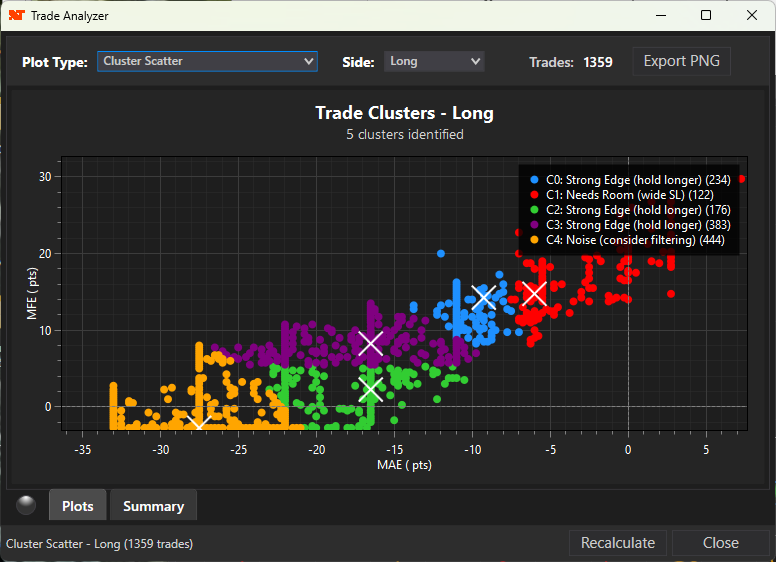
This plot groups your trades into clusters based on similar characteristics, then displays them color-coded on the MFE/MAE scatter:
• Each color: A different cluster of similar trades
• Cross markers: Cluster centroid (average trade in that group)
• Legend: Cluster ID, archetype name, and trade count
Clusters are formed using k-means algorithm on:
• MFE and MAE values
• MFE/MAE ratio
• Time to reach MFE and MAE
• Whether MFE or MAE was hit first
How to Read It
Archetype Classifications:
Archetype |
Location on Plot |
Characteristics |
|
Fast Winner |
Upper-left |
High MFE, low MAE, reaches profit quickly |
|
Needs Room |
Upper-left but wide |
Fast |
|
Noise |
Near origin |
Fast |
|
Strong Edge |
Far upper-left |
Fast |
|
Mixed |
Scattered |
Fast |
Cluster Separation:
• Well-separated clusters: Distinct trade types - can be managed differently
• Overlapping clusters: Trade types blend together - single strategy may suffice
• One dominant cluster: Consistent signal behavior
• Many small clusters: Highly variable signal - needs filtering
How to Use This to Improve Trading
1. Apply Different Management by Cluster:
• Fast Winners: Use trailing stops to capture quick moves
• Needs Room: Use wider initial stops, then tighten
• Noise: Consider filtering these signals out entirely
• Strong Edge: Hold longer, use wider targets
2. Identify Entry Conditions:
If you can predict which cluster a trade will belong to at entry, you can apply cluster-specific management. Look for:
• Time-of-day patterns
• Volatility conditions
• Trend alignment
• Signal strength variations
3. Remove Bad Clusters:
If one cluster consistently underperforms (e.g., "Noise" cluster with 30% win rate), find what conditions produce those trades and filter them from your signal.
4. Focus on Best Clusters:
If "Strong Edge" trades only happen 15% of the time but produce 60% of your profits, find the conditions that create them and seek more of those opportunities.
Futures, foreign currency and options trading contains substantial risk and is not for every investor. An investor could potentially lose all or more than the initial investment. Risk capital is money that can be lost without jeopardizing ones financial security or lifestyle. Only risk capital should be used for trading and only those with sufficient risk capital should consider trading. Past performance is not necessarily indicative of future results.