
Deep Signal LOB Imbalance (Limit Order Book Imbalance)
Overview
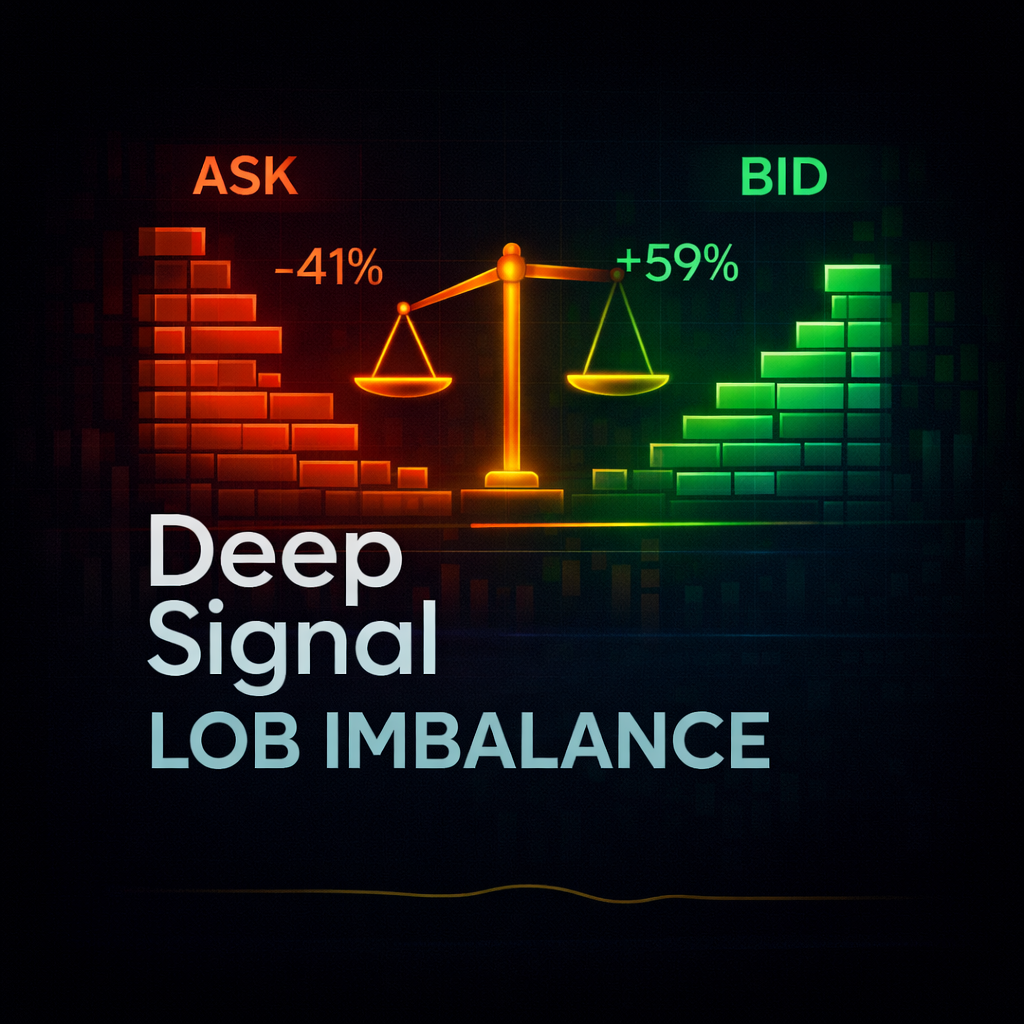
Deep Signal LOB Imbalance is a market microstructure indicator that measures the balance of liquidity between buyers and sellers in the order book.
By comparing the volume of resting bid orders (buyers) versus ask orders (sellers), LOB Imbalance reveals where pressure is building—before it fully manifests in price.
This allows traders to anticipate:
- Directional bias
- Short-term momentum shifts
- Liquidity-driven movesicators that rely on lagging price signals, LOB Imbalance operates directly on the order book, allowing you to anticipate shifts in supply and demand as they develop.
Key Features
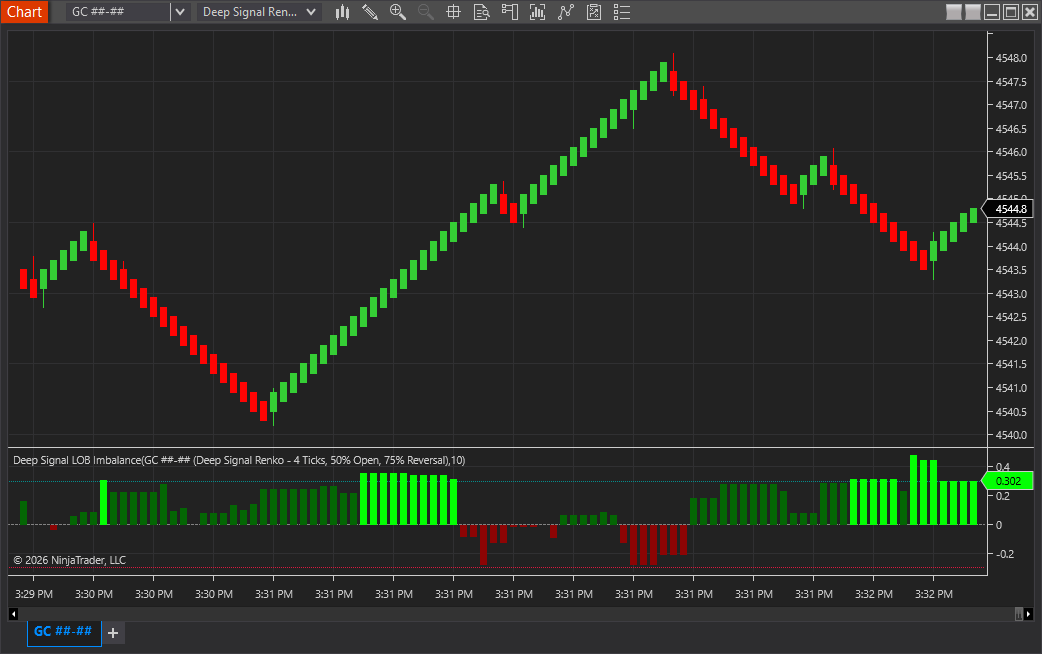
- Measures real-time bid vs ask liquidity imbalance
- Detects shifts in supply and demand before price moves
- Identifies hidden buying or selling pressure
- Adapts to changing market depth conditions
- Provides a continuous directional bias signal
- Level 2 Order Book Data is required
How LOB Imbalance Works
LOB Imbalance analyzes the depth of market (DOM) across selected price levels and computes the relative strength of buyers vs sellers.
Core Concept

- Values are normalized between -1 and +1
Interpretation
- Positive Imbalance (Buy-Side Dominance)
→ Strong bid support
→ Increased probability of upward movement
- Negative Imbalance (Sell-Side Dominance)
→ Strong ask pressure
→ Increased probability of downward movement
- Neutral / Balanced
→ No clear directional edge
→ Market likely consolidating or awaiting new information
How to Use LOB Imbalance
Core Use Case
LOB Imbalance is best used as a leading indicator of pressure, helping answer:
“Is liquidity supporting this move… or resisting it?”
Practical Applications
1. Directional Bias
- Positive imbalance → Favor long setups
- Negative imbalance → Favor short setups
2. Entry Confirmation
- Align entries with imbalance direction
- Avoid trades that conflict with strong liquidity pressure
3. Early Reversal Detection
- Watch for:
- Price rising while imbalance turns negative → potential exhaustion
- Price falling while imbalance turns positive → potential reversal
Strategy Guidelines
Scalping
- Use short-term imbalance shifts for quick entries
- Focus on rapid changes near key levels
- Combine with order flow tools (e.g., VPIN, OTR)
Intraday Trading
- Track sustained imbalance for trend continuation
- Use pullbacks into imbalance zones for entries
Swing Trading
- Use LOB Imbalance to confirm higher timeframe bias
- Look for persistent imbalance alignment with structure
Best Practices
- Focus on changes, not just levels
Shifts in imbalance often matter more than absolute values - Combine with price action
LOB Imbalance shows intent—not guaranteed execution - Be aware of spoofing / liquidity games
Large resting orders may be added or removed quickly - Use with other Deep Signal tools
- VPIN → detect toxic flow
- OTR → detect excessive order activity
- Cobra → confirm directional reversals
Example Workflow
- Identify a potential setup (support/resistance, breakout, Cobra signal)
- Check LOB Imbalance:
- Positive → supports long bias
- Negative → supports short bias
- Monitor for shifts:
- Divergence between price and imbalance → early warning
- Execute with confirmation from price action
Summary
Deep Signal LOB Imbalance provides insight into real-time liquidity pressure within the market.
- Detects where buyers or sellers are stacking the book
- Helps anticipate short-term moves before price reacts
Futures, foreign currency and options trading contains substantial risk and is not for every investor. An investor could potentially lose all or more than the initial investment. Risk capital is money that can be lost without jeopardizing ones financial security or lifestyle. Only risk capital should be used for trading and only those with sufficient risk capital should consider trading. Past performance is not necessarily indicative of future results.