
Ordering Scatter Plot
What It Shows
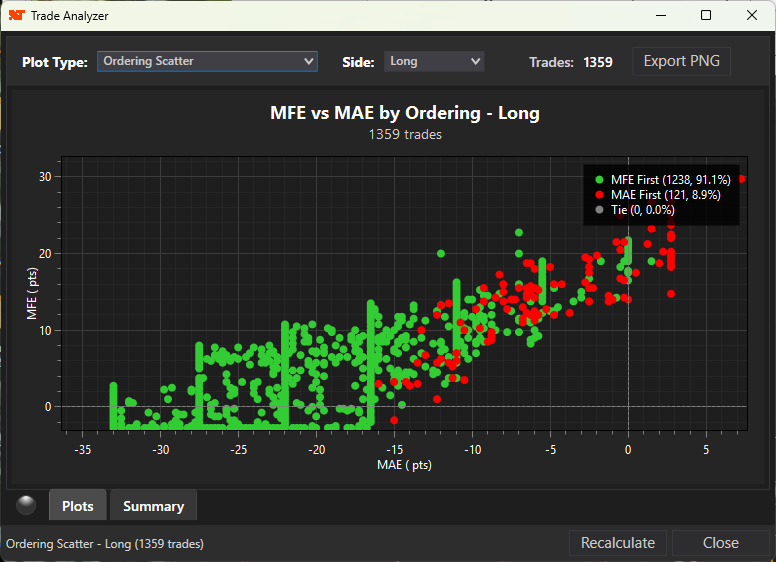
The same MFE vs MAE scatter, but color-coded by ordering - whether the trade hit its maximum favorable excursion or maximum adverse excursion first:
• Green dots (MFE First): Price moved in your favor before moving against you
• Red dots (MAE First): Price moved against you first, then recovered
• Gray dots (Tie): MFE and MAE were reached at the same bar
The legend shows counts and percentages for each category.
How to Read It
Color Distribution Patterns:
Pattern |
Meaning |
|
Mostly green (>60% MFE-first) |
Signal moves quickly in your favor - good for trailing stops |
|
Mostly red (>60% MAE-first) |
Trades typically experience drawdown before profit - need patience |
|
Mixed colors evenly |
No consistent pattern - use fixed TP/SL |
|
Green in upper-left, red in lower-left |
Best trades are fast movers; struggling trades had drawdown first |
Location Correlation:
• Green dots high on Y-axis: MFE-first trades produce good profits
• Red dots high on Y-axis: Even MAE-first trades recover well
• Red dots low on Y-axis: MAE-first trades don't recover - filter these
How to Use This to Improve Trading
1. Choose Your Management Approach:
• High MFE-First rate (>55%): Use trailing stops. Your trades tend to move quickly in your favor, so lock in gains as price advances.
• High MAE-First rate (>55%): Use fixed TP/SL with wider stops. Your trades need room to work before becoming profitable.
• Mixed (~50/50): Either approach works. Test both.
2. Trailing Stop Design:
If MFE-first trades are common:
• Start trailing immediately after a small move in your favor
• Use a tighter trailing distance
• Focus on capturing the initial momentum
If MAE-first trades are common:
• Don't trail until price shows clear direction
• Use a wider trailing distance
• Be prepared for drawdown before profit
3. Filter Low-Quality Trades:
If red dots (MAE-first) in the lower-left consistently fail to recover:
• These trades experience drawdown and don't profit
• Find entry conditions that produce these
• Filter them from your signal
4. Validate Stop Placement:
For MAE-first trades (red dots):
• Check how far left they extend (maximum drawdown)
• Your stop must survive this drawdown
• If stops are too tight, you'll exit before the recovery
For MFE-first trades (green dots):
• Tight stops work well because drawdown is minimal
• Focus on trailing to maximize the favorable move
Futures, foreign currency and options trading contains substantial risk and is not for every investor. An investor could potentially lose all or more than the initial investment. Risk capital is money that can be lost without jeopardizing ones financial security or lifestyle. Only risk capital should be used for trading and only those with sufficient risk capital should consider trading. Past performance is not necessarily indicative of future results.