
TP/SL Expected Value Heatmap
What It Shows
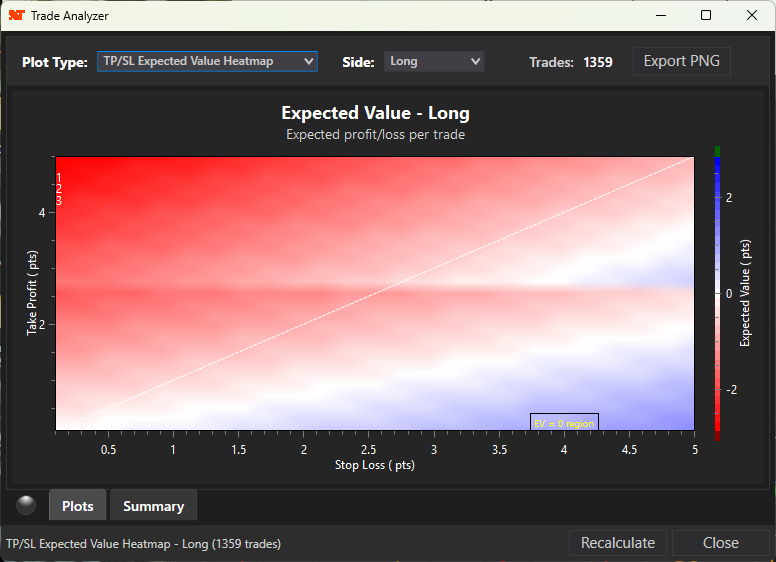
This is the most important plot for optimizing profitability. It shows the Expected Value (EV) - average profit per trade - for every TP/SL combination:
EV Formula: EV = P(win) × TP - P(loss) × SL - Costs
• Colors: Green = positive EV (profitable), Red = negative EV (losing)
• Gold stars: Top 3 best TP/SL combinations ranked by EV
• White diagonal: 1:1 risk/reward reference
How to Read It
Color Zones:
• Dark green/blue: Strong positive edge - these TP/SL settings make money
• Light blue: Marginally profitable
• White/neutral: Break-even (EV » 0)
• Red: Negative edge - these settings lose money over time
Star Rankings:
The gold stars mark the optimal zones. Star #1 is the single best TP/SL combination discovered in your data. These are your target settings.
How to Use This to Improve Trading
1. Use the Optimal Settings:
The #1 star shows your mathematically optimal TP/SL combination. If it shows TP=2.5, SL=1.8, this specific combination maximizes your expected profit per trade based on historical data.
2. Find the Profitable Zone:
Don't just use a single point - identify the entire green region. This shows all profitable combinations. You have flexibility within this zone.
3. Understand the Trade-offs:
Moving from star #1 to #2 or #3 might mean:
• Similar EV but higher win rate (better psychology)
• Similar EV but tighter stops (less capital at risk)
• Slightly lower EV but more robust across conditions
4. Avoid Red Zones:
If your current TP/SL is in a red zone, you're fighting math. The data shows these settings lose money regardless of trade selection.
5. Check for Green/Blue Zone Location:
• Green zone above diagonal: Your signal has a genuine edge
• Green zone only below diagonal: Edge depends on wide stops or small targets - fragile
• No green zone: Signal may not be profitable with any fixed TP/SL - consider other exit methods
Futures, foreign currency and options trading contains substantial risk and is not for every investor. An investor could potentially lose all or more than the initial investment. Risk capital is money that can be lost without jeopardizing ones financial security or lifestyle. Only risk capital should be used for trading and only those with sufficient risk capital should consider trading. Past performance is not necessarily indicative of future results.